
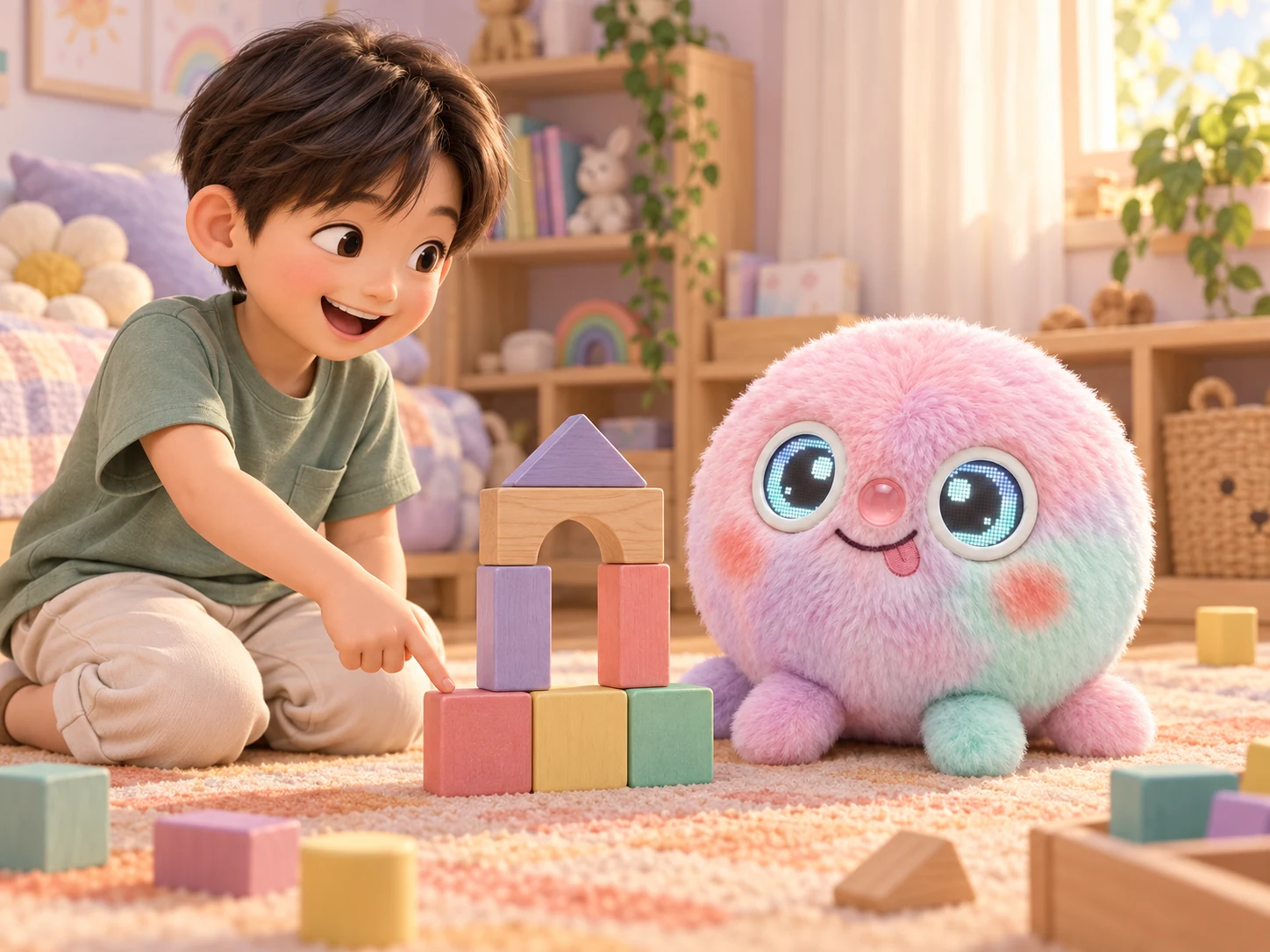
An AI plush combines a soft character with intended AI interaction. A smart speaker combines a voice assistant with speaker-based household features. Neither label tells you the exact play experience, privacy, age suitability or ongoing cost. Compare the specific product with the job your family wants it to do.
First, choose the role.
“Something with AI” is a very broad shopping brief. A more useful brief might be “a way to play our music,” “a character for pretend adventures,” or “a toy my child can explain their dinosaur collection to.” Those requests can lead to different choices.
A smart speaker may include music, questions, reminders or connected-home features. For example, Google’s current speaker page describes media playback, voice-assistant help and household controls. Specific features have their own account, region and subscription conditions. Google Home Speaker’s official feature overview is a useful example of the details to check.
An AI plush is a product category, not a common specification. One might center on stories, another on conversation or structured activities. A soft exterior alone does not tell you what the software can do.
Swipe to compare both columns. Keyboard users can focus the table and use the arrow keys.
| Your question | AI plush | Smart speaker |
|---|---|---|
| What role does it play? | Look for the character’s actual role in conversation, stories or play. | Look for the household and media tasks you want the assistant to handle. |
| What does the child do? | Check whether they direct an idea, answer a quiz, listen or follow a script. | Check how requests, conversations and media controls work for a child’s account. |
| What happens without a connection? | Ask which electronic features stop and whether any local play functions remain. | Check which functions depend on the network and linked services. |
| What can a parent control? | Ask about microphone controls, content boundaries, records and deletion. | Check device and account controls, linked services and who can access them. |
| What is the total cost? | Check the toy, required app, subscriptions, accessories and support terms. | Check the device, media services and any paid assistant features you need. |
This is a decision framework, not a benchmark. It does not claim that every product in either category has these features.
Try the decision in three moments.
“Put on our favorite music.”
Write down the music service your family uses and the controls you need. Then check a speaker’s compatibility, account requirements and costs. A plush character is not automatically a substitute for that job.
“Come and see the city I built.”
This is an invitation into a child’s world. If you are considering an interactive character, ask to see how it responds to a child’s own explanation, including when it misunderstands. A scripted promotional scene cannot settle that question for you.
“The dragon has opened a bakery.”
You may not need another device. An ordinary plush, drawing or willing grown-up can take a part in the story. If you choose a connected character, decide what you want it to add beyond what you already enjoy.
A friendly face is not a privacy policy.
For either category, ask what starts the microphone, where voice data goes, whether recordings are retained, who can review them and how to delete them. Also check the recommended age and how an adult manages the device. These are product-specific questions.
Controls can involve more than a switch. For example, Google’s current documentation describes supervised accounts, membership in the home, media filters and scheduled downtime. It also explains limitations of those controls and advises supervising a child’s use. Read the provider’s current details for your device and country: Google Home parental controls and Digital Wellbeing.
Try an ordinary interruption in a demonstration: a child changes topic, gives an unexpected answer or wants to stop. Ask what is stored and what the device does next. A list of features is useful; a clear account of their limits is useful too.
Where does Wompy fit?
Wompy’s intended role is a curious beginner in child-led play. A child gets to explain, invent or tell the story. In our website’s hat workshop, Wompy wonders whether a triceratops needs three hats; the child’s choice leads to an illustrated invention.
Wompy is available for preorder. The Wompy team confirmed on 26 September 2026 that the conversation experience and companion app are complete, with finalized guidance for ages 5+ and finalized privacy controls. The website uses prewritten choices and outcomes; it does not connect to live AI or test the hardware. Read the Wompy product facts and contact support@wompy.world for the app link, supported devices and detailed privacy information.
This guide does not rank Wompy above a smart speaker on measured performance: no comparative hardware test was conducted. Use the different roles to decide what interests your family, then check the product’s requirements and purchase terms.
The intended Wompy moment
“I made the hat bigger so all three horns fit.” A child explains an invention to a character who is curious about it.
The household-helper moment
“Play the album we picked.” A family asks a device to complete a task using its supported services.
The examples illustrate different roles. They are not transcripts from a Wompy hardware test or a claim that smart speakers cannot support creative play.
A better shopping brief.
- Name one moment you want to make easier or more enjoyable. Be specific enough to recognize it in a demonstration.
- Check whether what you already have can do it. A favorite plush or an existing speaker may be enough.
- Ask for the exact requirements. Age guidance, connectivity, accounts, data handling and support are part of the product.
- Compare the full cost and actual availability. A planned price and an item ready to ship are different situations.
- Look for fit, not the biggest feature count. Choose only when the demonstrated experience and final terms suit your family.
For more detail, keep the seven questions before buying an AI toy nearby. To explore Wompy’s creative direction today, try a small, complete scripted play experience.
Sources & perspective
This guide is published by Wompy. It compares intended roles and buying questions, not measured performance. No comparative hardware test was conducted. Wompy product statements refer to the current product facts.
- Google Home Speaker — official product overview. Used as one example of a smart speaker’s feature and service information. Reviewed 26 September 2026.
- Google Home and Nest Help — parental controls and Digital Wellbeing. Used for the account, filter and downtime example. Reviewed 26 September 2026.
Product features and regional availability can change. Check the current provider documentation before buying. Read our editorial approach.
One little question.
Their very own answer.
Meet the curious plush your child gets to teach.
Preorder Wompy · US$129 Preorders open · Full product payment now. Shipping extra.Try a little play first